Heavy machinery is a significant source of carbon dioxide emissions that negatively impacts the environment. A machine consuming 35–40 liters of diesel per hour can emit approximately 1,000 kg of CO₂ in a single working day.
In response to these concerns, many countries are implementing mandatory requirements for the disclosure and reduction of CO₂ emissions:
- European Union: CSRD/ESRS initiatives, ETS2 regulations starting in 2027, and HDV targets through 2040.
- United States: EPA HDV Phase 3 requirements and increasing investor demands for climate risk disclosure.
- Asia: ISSB-aligned standards (Japan, Singapore, Hong Kong, South Korea) set to take effect from 2025 to 2026.
- Latin America: Transitioning to mandatory disclosures in countries like Brazil, Chile, and Mexico.
Feltach’s solution for CO₂ monitoring and fuel control assists in measuring emissions and reducing your carbon footprint, while also lowering fuel consumption and extending equipment lifespan ensuring compliance with environmental standards.


Benefits of Feltach’s solution
CO₂ emissions monitoring based on actual fuel consumption
Direct measurement of fuel consumption in engine fuel lines provides high accuracy of CO₂ emission calculations and detailed breakdown by shifts, operations and operating conditions.
Remote diagnostics and optimization of machine operation
Timely maintenance, prevention of fuel system failures and optimal machine operation reduce fuel consumption and the resulting CO₂ emissions.
Data integration into GLONASS and telematics systems
Information on fuel consumption and engine operating time in different load modes is integrated into fleet management systems and the company’s analytics tools.
How CO₂ Emissions Monitoring Works on Machinery
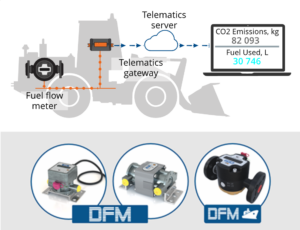
The cornerstone of the monitoring system is the DFM fuel flow meter, which precisely measures fuel consumption in the engine's fuel lines, logs engine operating time, and enables real-time calculation of CO₂ emissions.
Data on fuel consumption and CO₂ emissions collected from the measuring devices is transmitted to the CANUp telematics gateway. Here, an automatic report is generated and sent to the cloud system UNUM IIoT (or another compatible platform). This seamless process allows for efficient monitoring and management of emissions, ensuring compliance with environmental standards.
Fuel Consumption and CO₂ Emissions
- Total Fuel Consumption
- Resettable Fuel Consumption
- CO₂ Emissions Volume
- Supply Line Fuel Consumption
- Return Line Fuel Consumption
- Average Consumption Over a Period